Land Law 101: English Land – Māori Whenua


In order to effectively govern as an MP, and to be part of the solution not part of the problem, understanding the purpose of law, and then understanding the purpose and basis of land law is essential. Land law is the law of immovables. That which can be touched but is not intended to move from one place to another. Territories are claimed. Boundaries are marked. Ownership is established and defended.

  • The English, starting in 1066 AD developed a concept of land ownership called sovereignty that continues to this day in New Zealand
  • Māori have a very different relationship to land called mana whenua, where the collective people who live on the land are called tangata whenua.

Unfortunately for New Zealand, too many students of government and even law students seem to have slept through Property 101. This is further complicated by Te Tiriti o Waitangi where two very different concepts of land and property law were married.

As a result, one finds regulatory creep where (if you pardon the pun) the boundary of law has been moved by advocates and bureaucrats over time.

The point of law is that it does not move except by due process, meaning changed by majority vote in a democratic system of governance. Over the past 20 years this regulatory creep has happened with land and property law, to the point where a restatement is deemed necessary.  For example, the idea of Māori sovereignty sounds appealing to advocates, but if properly using the word sovereignty, it makes no sense whatsoever. It’s not how Māori worked when it came to whenua.

What is Law? 

Law is a social contract in which humans who live in proximity develop agreements to get along with each other. There are two fundamental origins of law: 

  1. Agreement: The adults agree to get along. Typically this emerges out of a family where parents lay down the law and the young agree or suffer consequences.
  2. Conquest: A warring party fights and dominates another people, and then lays down the law to which the losers agree in order to survive after conquest.

In either case, law begins informally and over generations – especially if the culture uses written language – become more codified. Eventually, law becomes so complicated a class of experts called lawyers and judges emerge to interpret the written law as agreed to by a formal governance body. In NZ it’s called The Crown.

What is Property Law?

Tangible: Property consists of tangible property (things that can be touched) and intangible things (things that cannot be touched).

Realty vs Chattel: In this page, focus is on tangible property, and more specifically immovable property (called realty: land and anything fixed to land, such as a stone wall or a castle) and property that can be moved (called chattel  such as a dumped pile of stones that may become a wall or castle, but at present is not). The grey area comes when it is unclear if the property is fixed to land or not, and in such cases the courts make decisions, often based on intent, that can be precedent setting, meaning once decided for that case, it is not overturned except by new and explicit law.

Sovereignty: The above distinction is based on English Law, also called Common Law. In short, since 1066 AD, all land within the realm (all of NZ) is owned by the Sovereign, also referred to as The Crown presently in the titular name of King Charles III. What we call realty or real property/real estate is a bundle of rights granted by the Crown, not ownership. A Kiwi can own cattle (a word related to chattel), but only owns fee simple rights to the paddock upon which the cattle graze. Those rights seem so strong that ordinary folk regard them as absolute, but in law this is an illusion. It’s not real.

Colonial Law: This sovereign concept of land ownership became more complicated when the British Empire started colonising the planet. In colonisation, the Western Powers agreed to the International Law of Colonialism where one nation claims ownership of foreign land, after which another nation can only take ownership by conquest (Norman), treaty (Waitangi), purchase (Alaska) or revolution (American).

Eurocentric: The native peoples who were colonised had no say in the establishment of International Law of Colonialism and in many cases the land the colonial power “discovered” were already occupied by native peoples who held absolute ownership of land in accordance with their own social contracts. International law had procedures for dealing with colonising lands already occupied, but they were agreements made among Western powers, not the natives already there.

Since New Zealand (Nu Tirani in Te Tiriti o Waitangi) was colonised under the International Law of Colonialism, it’s important MP’s understand its basis in law:

Sovereignty

THE KING HOLDS ABSOLUTE OWNERSHIP OVER ALL THE LAND

To understand Western governance, one must begin with Christianity, most notably Genesis 1:29

And God blesses them, and God says to them, “Be fruitful, and multiply, and fill the earth, and subdue it, and rule over fish of the sea, and over  bird of the heavens, and over every living thing that is creeping on the earth.

Sovereignty means absolute ownership of land and supreme authority over people to establish a state of lawfulness. New Zealand sovereignty was born by conquest in 1066, in which supreme authority was vested in the Crown by divine right. But over time sovereignty increasingly became subject to a system of checks and balances requiring consent of the people by their elected representatives. In other words, it has moved from conquest to agreement, but NZ still has vestiges of conquest at its fundamental basis. When it comes to checks and balances, the collective government still holds absolute sovereign power because there is no written Constitution to which the people can appeal and to which the officials swear allegiance.

1066 AD: In 1065, England was controlled by several Earls, not one supreme king. The Earl of Wessex was Harold Godwinson. In 1066, Duke William of Normandy became William the Conqueror by defeating Harold at the Battle of Hastings. As King William I, he claimed absolute ownership over all land and everything fixed to land such as castles, as his own. He then issued a bundle of rights called realty (real estate / real property) where a landlord was issued a title. To cement this, in 1085 William recorded his ownership in the Domesday Book.
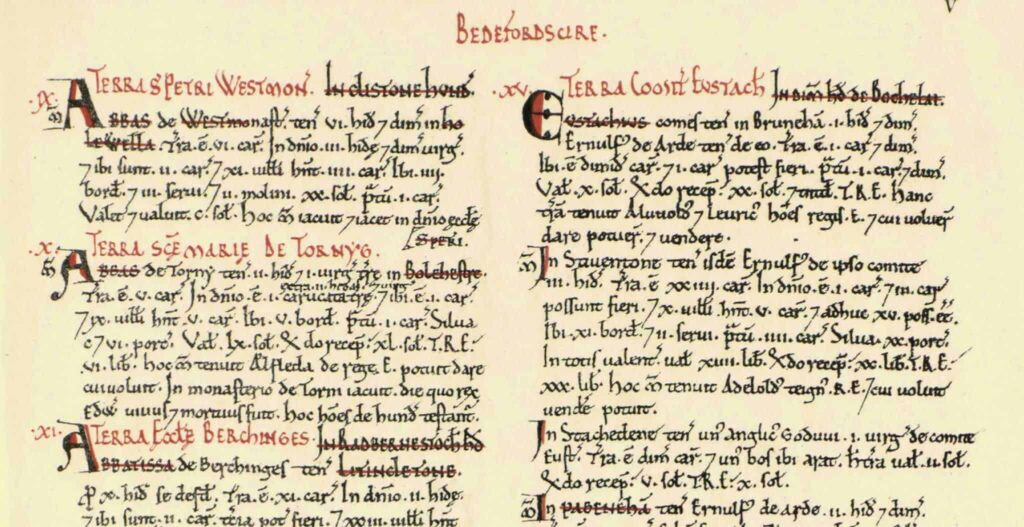
This is not a historic curiosity. It remains the basis of land law in New Zealand today. The Crown holds underlying absolute ownership of all land, be it in Māori title or Freehold. Over the centuries, the limits on Crown authority were both increased and codified, but there is no question that at law, all land and all fixtures attached to land are owned by the Sovereign. Any careful reading of the laws related to land makes this clear…
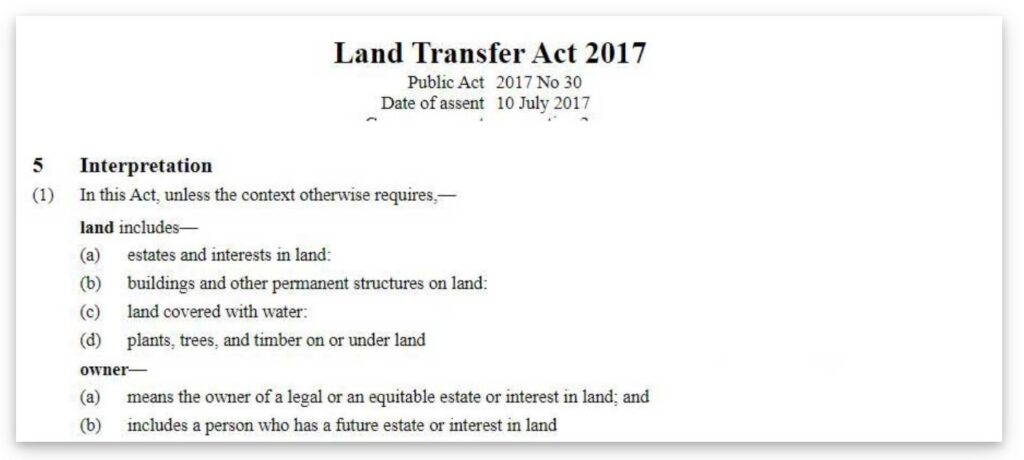
Estates & interest: When one buys fee-simple freehold land, one buys rights (estates and interest), not absolute ownership. These rights may appear to be absolute until the Crown takes land by eminent domain, or passes laws such as the Resource Management Act that gives the state (as delegated to the councils) authority to determine what improvements may be done on fee simple land. To make a change, one must apply for a consent.

While it is said Māori did not understand the legal concept of sovereignty in 1840, it would be reasonable to say in 2023 very few, including MPs understand the legal concept of sovereignty, especially in regard to land ownership, because it is rooted in archaic history of conquest that is alien to most in the 21st century.

No one (other than fringe groups like the Sovereign Person movement) question the supreme authority of the sovereign. As stated by Department of the Prime Minister and Cabinet: The King reigns, but the government rules so long as it has the support of the House of Representatives.

Because NZ forms political parties, and elected Members are compelled by their party to vote as a block, power is centralised to a small group of like-minded people, especially if under MMP, a single party wins over 50% of the vote. The cabinet holds extensive power where, with the exception of the power to demonstrate, protest or occupy land, the people have little say except at election time.

Mana

EARTH DOES NOT BELONG TO HUMANS, HUMANS BELONG TO EARTH

To understand Māori view of whenua, it is explained in whakatauki that set out a different relationship between humans and the Earth:

Whatungarongaro te tangata, toitū te whenua 
(People disappear, the land remains) and
Ko au te whenua, ko te whenua, ko au
(I am the land and the land is me)

Mana whenua: In order to understand the precolonial Māori social contract, it is essential to understand the concept of mana, of which mana whenua (land) was a central principle. Mana whenua comes from land held by a hapū, a tribe that descended from a common ancestor. Multiple hapū would recite their ancestry to a common iwi (which waka their ancestors sailed on), but iwi did not control land or serve as a collective level of governing.

Mana tangata: Hapū ruled supreme over their whenua, kāinga and taonga katoa, and the rangatira was their chief who ruled by a form of collective decision-making in the hui. If a rangatira lost the confidence of the hui, the chief’s mana tangata was lost. No impeachment or recall vote, loss of mana would be immediate, obvious and devastating. This served as a brake on the people who may not like the decision made by their rangatira, but accept it in respect to the chief’s mana.
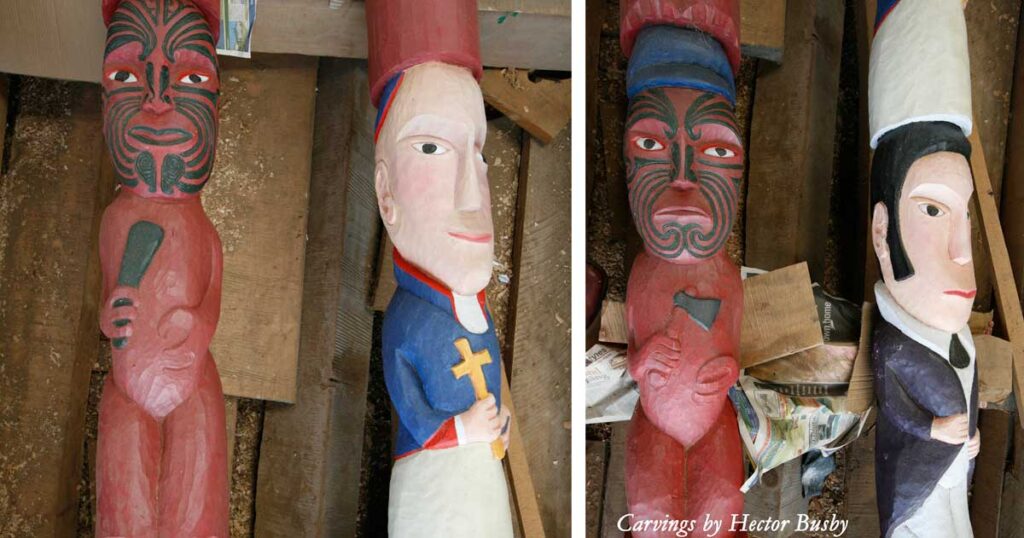
Mana whenua was claimed and defended, but was not rigidly fixed.

Prior to arrival of European technology, agricultural, weaponry, money and law, Māori were predominantly a hunting/gathering culture where one tribal territory abutted the next because all of it was needed for food. When Europeans arrived, they altered the Māori economy by bringing livestock, seed, farm implements and farming knowledge which Māori adopted.

This meant a need for less land, but fed a need for money to buy these European advances. One way to raise money was for hapū to sell surplus land. In doing so fully understood they were abjuring mana. For example, in 1897 at the Native Land Court, rangatira Neho Keepa testified “All the earlier tupapaku (ancestral bodily remains) were removed  [from Matiatia] to Wharekawa (the Miranda Coast)… on account of the uncertainty as to whether this land would be sold or not...” By removing the tupapaku, the tribe was relinquishing its mana over that land.

It is alleged Māori lacked the legal capacity to understand the concept of sovereignty, thus did not do so in Te Tiriti o Waitangi. However, while the rangatira at Waitangi did not have legal training in principles of Common Law or the International Law of Colonialism, it is clear they understood they were giving up absolute ownership over whenua they regarded as surplus to their requirements. In Māori terms, they were giving up claims to the whenua in question. Otherwise, they would have demanded utu.

To be clear, this does not apply to land that was confiscated by subsequent wars or other reasons for which the Waitangi Tribunal is making reparations.

Subdue or Kaitiakitanga – which is more aligned with the present?

Sovereignty is a historic vestige from a time when kings ruled and claimed their right as divine, meaning it came from God and they were accountable to God, not to the people over whom they reigned. Christianity was ever-present in the people’s lives, and indeed to this day, crowning of the King/Queen is a Christian ritual. Unfortunately for the planet, the injunction in Genesis 1:28 has actually come to pass. Humans have subdued the earth. They have filled almost every arable corner of it, and believe they rule the birds of the air, the fishes of the sea and all that moves across the land, although by rule, it seems to mean bringing fauna (and flora) to extinction.

As humanity becomes more aware of its environmental footprint, the Māori worldview of kaitiakitanga becomes more relevant. As the NGO Conservation International reminds us: “Nature doesn’t need people. People need nature.”

Baggage: This opens up a very interesting possibility for New Zealand – the new sea land – to move beyond sovereignty to a legal system in which land is not owned, it is cared for. Title to land continues, but the concept of sovereignty with its negative historic baggage is left behind.

Law of Empires: Curiously, the arguments Māori make in regard to whether the British Empire did or did not secure sovereignty by Te Tiriti are based on western international law of colonialism. They argue while sovereignty was claimed in the English version, in Te Tiriti, the rangatira representing hapū only granted kāwanatanga, not mana whenua, meaning sovereignty – absolute ownership of all land by the Crown in the person of the Queen or King of the day – was never secured. This is a curious state of affairs where Māori are demanding their rights under English and Colonial Law while asserting English and Colonial Law was never properly ratified and therefore lacks legitimacy. To argue illegitimacy from a platform declared as illegitimate by those advancing the argument creates an oxymoron and only stands because until recently, with the apparently-serious proposal for co-governance, there was no pushback. 

A New Hereditary Aristocracy: This argument came to the fore under the 6th Labour Government when the concept of co-governance moved from an academic discussion to a political platform that would in law create a new hereditary aristocracy in which authority was vested based on ancestry (think House of Lords in the UK) not election by the people (think House of Commons in the UK). While the Crown has the supreme authority to whatever it wants, it is historically dishonest to say it is compelled to do so based on Te Tiriti, or to use the current political jargon, it is based on misinformation or disinformation.

Regulatory Creep

On 29 July 2020, the government received an independent review of the Resource Management Act (RMA). The nearly 600 page document, prepared by retired Court of Appeal Judge Tony Randerson QC, gives advice on how to move forward by practically repealing the RMA and starting again. In that report, the term ‘mana whenua’ is proposed to be defined as “‘an iwi, hapū or whānau that exercises customary authority in an identified area.”

Customary: This is not historically accurate. The word “customary” greatly expands the territory, to include land that was sold by competent hapū and whānau under the protocol set out in Te Tiriti. The records of the Native Land Court clearly show the hapū who petitioned to sell land fully understood they were relinquishing mana over the land they were selling. Such land was surplus due to their shift from hunter-gatherers with minor kūmara agriculture to farmers in which almost all food was grown using imported seed, livestock and farming methods.

iwi never exercised customary authority because the highest form of authority was hapū. This would be like the United States granting customary authority to families who trace their ancestry back to the Mayflower.

Why this matters

People need certainty in their lives. Tūrangawaewae – having a place to stand tall on the planet – is fundamental to human wellbeing, and it is attained by a careful balance between the needs of society and needs of the individual. New Zealand was colonised predominately by the losers in the Norman Conquest of 1066. The Anglo-Saxons, Celts and Norse who were conquered by William became tenants in their own land. They became subservient to an overlord class who claimed ownership rights over land the conquered people’s ancestors had owned until William confiscated them by right of conquest. The descendants of those tenants took the arduous journey to the other end of the earth to start a new life in which there were no overlords. They did not conquer the native peoples, they intermarried, to the point that today there are hardly any natives left. All are what in Latin America is called mestizo, persons with mixed ancestry.

Land owning may be a bundle of rights granted by the Crown, rather than absolute, but it is important to Kiwis, regardless of ancestry or DNA.

Increasingly, the right to change ones land, such as constructing a new home or structurally changing an existing one comes with an overlay of consent charges and delays that are becoming burdensome. In almost all cases, the consent is eventually granted, but not until one has paid a new class of experts to write the application in a form the council accepts after charging substantial additional fees and sometimes contributions that mean less money for bricks and mortar, less for the beauty in the finishing materials because the available money ran out.

To add a mana whenua cultural overlay, be it a mana whenua review of a consent application paid by the applicant, or use of rates to pay for the services of a new hereditary class that is paid by council for consultation, seems a step backwards. Councils need kaitiakitanga, but it should be based on knowledge, understanding and field experience, not ancestry.

The recent 2023 election saw a repudiation of co-governance in the switch from a Labour government to a National government, but there does need to be a more nuanced way forward. The idea of a hereditary class granted powers due to ancestry seems a backward step for the nation, but at the same time, sovereignty appears as a historic vestige that perhaps should be retired in favour of kaitiakitanga. 


CASE STUDY

“Mana whenua is an iwi, hapū or whānau that exercises customary authority in an identified area.”
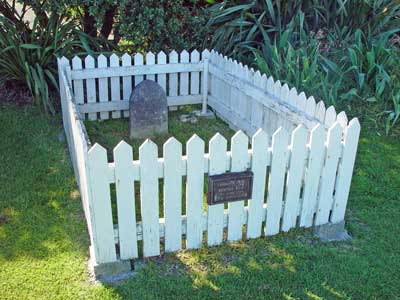
On Waiheke Island, most visitors and residents arrive by ferry at Matiatia, but few notice the picket fence on the foreshore that is the urupa of a former Taranaki Māori slave who was brought to Waiheke by with his former owners, the tangata whenua, released from bondage by Te Tiriti, and was given Matiatia valley as tuku whenua (right to occupy) where he was buried and is still honoured to this day. Matiatia exemplifies the realty of Te Tiriti, and it is worthy of a review for those still reading this page. It is helpful that historian Paul Monin wrote a book, Matiatia Gateway to Waiheke that documents the history.


In about 1700, Ngati Paoa, a hapū of the Tainui iwi began to extend settlement onto Waiheke Island. Their mana was contested by Ngati Maru, Ngati Rongo, Te Kawerau as well as the earlier tribes of Patukirikiri, Nga Tai and Te Urikaraka with conflicts and killings. With colonialism came firearms and Ngapuhi under Hongi Hika was quick to adapt to the new, much more lethal form of warfare. He came down to the Hauraki Gulf and launched massive raids on the Hauraki Tribes, including Ngati Paoa with devastating effect. Ngati Paoa fled south to the Waikato and did not return to Hauraki for another decade. They were joined there in 1831 by freed Hauraki slaves who returned from the Bay of Islands.

Of these was future rangatira Wiremu Hoete who had been released from Ngapuhi captivity in the Bay of Islands. As a boy, the enslaved Hoete had been placed in the Anglican Mission at Paihia and on his return to Hangaura he built a raupo chapel at what became known as Church Bay. His mana and that of his whanau extended over Te Huruhi, the western peninsula from Oneroa Bay to Huruhi Bay, what now is called Matiatia Estates, Matiatia wharf and valley, Church Bay Estates and Park Point.

Hoete married Hira who was part of Ngati Te Ata, a Waikato tribe whose father captured a number of slaves, including a young boy, Rapata Te Rou, who was called The Taranaki from the Taranaki tribe Hira’s father defeated. This Taranaki was exceptionally industrious. As a means of rebuilding his mana lost when he became a slave,  the generous and devout Christian, Wiremu Hoete and his wife Hira, gifted Matiatia to Ropata Te Rou as tuku whenua in which land use is gifted, but mana whenua is retained. If they cease to occupy, land reverts to the mana whenua.

Ropata owned five sailing vessels in succession, transporting firewood, horticulture and livestock to Auckland over a 30-year period until he died in 1894. He had fully adapted to English technology and farming. Over the hill in Church Bay, Hoete ran productive farms with woolsheds as well as horticulture growing potatoes and other crops. However, when that generation passed on, subsequent mana whenua petitioned the Native Land Court to partition the whanau land in 1894. In 1897, the Native Land Court accepted the Māori application and partitioned Te Huruhi, the commonly-held whanau land into 13 blocks that eventually became about 40 titles with numerous absentee owners non-resident on Te Huruhi. By 1911, when Native Land Court restrictions on land sales effectively disappeared, te absentee owners rushed to have their sections surveyed so they could be sold. Gradually, Pākehā farmer Fred Alison and his wife Anna Frances purchased these Māori titles until they amassed ownership of 2,360 acres. By October 2014, the last Ngati Paoa community departed Waiheke, ending over 150 years of occupation. At Matiatia, as mentioned above, All the earlier tupapaku (ancestral bodily remains) were removed  [from Matiatia] to Wharekawa (the Miranda Coast)… as the mana whenua connection to the land became tenuous. The bones found at Matiatia were those of the Taranaki, the former slaves and tuku whenua, not mana whenua, not Ngati Paoa.

While some Māori families remained, with five families living on Waiheke, they lived on freehold land, travelling by ferry to jobs in Auckland. They ceased to be whanau or hapū with tino rangatiratanga over whenua, kāinga and taonga katoa, as they had adopted a western lifestyle.

Then in 2003, Matiatia became of interest when Fay Richwhite partners as Waitemata Infrastructure Limited (WIL) purchased the freehold title at Matiatia, including the Alison homestead and carpark and proposed a Private Plan Change to rezone the land for a boutique hotel and high-end visitor amenities. The Waiheke community was almost universally opposed, and soon united the opposing submitters into the Community and People of Waiheke Island (CAPOW). They raised funds, retained legal and expert representation. They were united except for one notable standout: Ngati Paoa Whanau Trust. When a second consent application was lodged there were 759 submissions in opposition and one in support, from the Ngati Paoa Whanau Trust in the name of Hariata Gordon, not resident on Waiheke. At the time, mana whenua did not have the hereditary status they have today, and it was general knowledge at the time that the Whanau Trust received compensation for their submission in support. In the end, the threat to Waiheke was resolved when newly-elected Mayor Dick Hubbard prompted the Auckland City Council to purchase WIL and Matiatia for $12 million, ending the plans for a hotel and entertainment centre at Waiheke’s gateway.

In 2010, with increasing interest by the Piritahi marae (an unusual marae in that it was created cooperatively by Pākehā and Māori (primarily driven by the vision of Ngapuhi kaumatua Kato Kauwhata, who was not not tangata whenua), on preserving the urupa of Rapata Te Rou, the Auckland City Council commissioned a ground radar study that found indications of other buried tupapaku. The historic record shows these were not the remains of tangata whenua or mana whenua, but of former slaves who had been granted tuku whenua that eventually became a marketable title approved by the Native Land Court and sold as freehold land to Pākehā.

With such a history, where the mana whenua / tangata whenua had vacated the whenua over a century before, what in Te Tiriti o Waitangi grants a residual customary right of mana whenua, as suggested by the Randerson Report?

Amend the NZ Bill of Rights to align with the UN Universal Declaration of Human Rights

A constitution sets out the powers of government. New Zealand does not have a written constitution.

A bill of rights sets out clear boundaries to protect the individual from the government. The NZ Bill of Rights is a law that can be repealed like any other law.

Governments are not tested in normal times. The test comes in times of crisis, emergency, when the social contract is under pressure. When that happens, if the powers accorded to government lack certain checks and balances, damage can result. The time to examine the limits of government are not during the crisis, but before or after. 

With its unicameral Parliament and the political party system, power is centralised within a small circle consisting of senior party members, either of one party or an MMP coalition. During a crisis or emergency, there is a much greater risk the decisions by this small cohort can get it wrong, especially if there is a public level of fear.

In this governance brief, it is proposed the NZ Bill of Rights needs to be strengthened, and it needs to have more binding power than a simple Act of the Crown.


In 1948, the United Nations proclaimed the Universal Declaration of Human Rights. At that time New Zealand played a key role in the drafting of the declaration, supporting the inclusion of economic, social and cultural rights. However, the declaration is not a legally binding instrument. New Zealand has ratified, with some reservations, the International Covenant on Civil and Political Rights (1966) and its companion the International Covenant on Economic Social and Cultural Rights (1966). New Zealand has incorporated some of the rights they recognise into domestic law.

In New Zealand, as in many other countries that adopt the common law legal system, an international human rights instrument becomes part of the domestic law only if this is provided for by Parliament. In New Zealand, none of the international human rights instruments has been completely adopted into domestic law. Only parts of each international human rights instrument have been included in New Zealand law.

New Zealand gives effect to international human rights instruments through two general human rights laws – the Human Rights Act 1993 and the New Zealand Bill of Rights Act 1990.  Despite its name, the Human Rights Act only focuses on one human right, the right to be free from discrimination. It prohibits discrimination on many grounds. The prohibited grounds of discrimination include sex, race, colour, religion, sexual orientation, disability and marital status.

The New Zealand Bill of Rights Act is broader. Its focus is on the protection of civil and political rights.

It protects:

  • the right to life and security of the person;
  • the right to political participation;
  • the rights of free expression, association, religion and thought;
  • the right to be free from discrimination;
  • the right to enjoy a minority culture; and
  • many rights related to the criminal justice system.

Notably absent from the New Zealand Bill of Rights Act are economic, social and cultural rights. There is no protection for

  • the right to a job
  • the right to education
  • the right to adequate housing
  • the right to social welfare
  • the right to privacy
  • the right to property
  • third-generation rights such as the right to a clean environment.

In many countries bills of rights are part of the supreme law of the country, which means that all other law must respect the bill of rights or be set aside. That is not the position in New Zealand. Under New Zealand’s constitutional arrangements, Parliament is supreme and is free to enact legislation that is inconsistent with the New Zealand Bill of Rights Act. The courts cannot strike such legislation down. But the courts can declare that a particular law, or part of a law, is inconsistent with the New Zealand Bill of Rights Act.42 A similar mechanism is available under the Human Rights Act in respect of discrimination.

When such a declaration is made by a court (or the Human Rights Review Tribunal) Parliament can decide whether and how it responds.

NZ needs a Bill of Rights that requires a much more rigorous process to repeal or overturn than a simple vote of the Parliament of the day.

In this brief, two rights are discussed…


Article 23: The Right to Work


The Universal Declaration of Human Rights, Article 23 states

  1. Everyone has the right to work, to free choice of employment, to just and favourable conditions of work and to protection against unemployment.
  2. Everyone, without any discrimination, has the right to equal pay for equal work.
  3. Everyone who works has the right to just and favourable remuneration ensuring for himself and his family an existence worthy of human dignity, and supplemented, if necessary, by other means of social protection.
  4. Everyone has the right to form and to join trade unions for the protection of his interests.

This right is not found in NZ law, and increasingly, the threat of losing ones job and career is used to secure conformity and obedience.  Some make the sacrifice, ruining their career out of principle or a deep and sometimes well-founded disagreement with the official party line. Most capitulate, but in doing so, the nation erodes confidence, trust and the social contract necessary for a free and open democracy – as well as losing some of its best workers – those who not only do, but who think about what they are doing.


Article 19: Freedom of opinion and expression


Everyone has the right to freedom of opinion and expression; this right includes freedom to hold opinions without interference and to seek, receive and impart information and ideas through any media and regardless of frontiers.

Under the banner of combatting misinformation, disinformation, fake news and organised strategies to manipulate public opinion, governments are developing laws and regulations ostensibly to suppress that which runs counter to the official narrative. While situationally the officials and the majority may believe they are right, history is littered with the collateral damage of the best of intentions enacted without sufficient checks and balances, including pushback by a minority. This becomes especially important as the fourth estate, the mainstream media is in retraction due to loss of supporting revenue where journalists are fearful of rocking the boat because it may mean not only loss of ones job, but ones career.

Democracy works when everyone has the right to express their opinions and views without censorship or repression, including the threat of losing ones job or career. It is well established that what is called the wisdom of crowds comes when many different people, thinking independently of each other are asked to address the same topic, while no individual may get it right, generally the crowd as a whole will. This is because different people see different aspects of the same subject. To learn more about why this works, read the Wisdom of Crowds essay.

If this freedom is supressed, society and civilisation are the losers. Politicians especially seek to control the narrative, but in doing so, they fail to achieve the public interest that is central to their job.


SLEEPWALKING INTO A DYSTOPIAN FUTURE


Google computerism and this definition pops up.

Computerism: A political ideology which maintains that all government power should be delegated to a computer or artificial intelligence.”

But the definition is not quite accurate. It’s not an ideology. It’s an accident. 

  • Tech wizards invent new technology because they think it is cool
  • Investors fund that technology because it will earn them a lot of money
  • A corporate management structure emerges that controls vast amounts of money, and the power money brings
  • They employ sales people who market to government agencies
  • Government agencies advertise jobs that attract employees who don’t rock the boat, don’t question the moral, political or ethical implications of the tools
  • Government agencies implement the new technology inventions – now nicely packaged, and build digital walls to insulate themselves from the public
  • Like the concentration camp workers – if called out, they claim they are just following orders, just doing their job. Unlike Nuremburg, they are not prosecuted
  • At the top, the elected officials have no training or intellectual capacity to understand what is happening. They approve the administration’s proposed laws
  • And the public, having become accustomed to technology in their lives, do not notice their loss of freedom until it is too late
  • Instead of a justice system, one has a violation notice system where an email issues a fine or a prohibition. To appeal is a penalty in itself.
  • Computerism takes hold. It runs every aspect of almost everyone’s lives.

Computer technology – that bundle of data capture, analysis, linking and gateway tools – gives bureaucracy powers unimaginable in earlier times.

The laws that govern use of such technology are inadequate. Because no top-down democratic decision was made to end democracy and shift to computerism, the response is sleepwalking into the tyranny of computerism.


When algorithms control the locks and wallets of society

photo: Trevor Paglen, CC0, via Wikimedia Commons

Christmas dinners bring together family and friends who, after the meal, song and laughter settle into reflective conversation recapping the year as it comes to an end. One cousin bemoans creeping socialism.

Another, more thoughtful relative replies: are socialism, communism and capitalism outdated analogue ideologies, and unless society and its leaders wake up, society will sleepwalk into computerism? From that conversation came this web page.

Socialism and capitalism are ideologies. They begin with thinkers, like Karl Marx, who look at what is, judge it as bad, and then set out a system of government management of the economy that is intended to cure society’s ills and bring about a utopia on earth. Such intellectual concepts tend to appeal to idealists who overlook the complexity of human nature. The systems they actually create to bring about harmony and comfort tend to become tools of tyranny. They very much appeal to academics during the theory stage and to power-seekers when they move into governance.

Computerism is a very different beast. It is not emerging from social theory, but from inventors and improvers. Techies, geeks, nerds, those people who are attracted to a creative toolset that begins with a keyboard, display screen and increasingly more powerful software applications that allow today’s inventors to build on yesterday’s accomplishments. 45 billion digital cameras, including a billion surveillance cameras capture the visual world, but their data needs increasingly intelligent AI computers to use algorithms that find the needles in the haystack. In 2022, there were 8.5 trillion digital money transactions, and 29 billion active credit cards, each trackable. As computerism grows, algorithms will be able to analyse every transaction. This will be made legal in the name of anti-money laundering and tax evasion, but once present, it will be used by law enforcement to target criminal activities.

The problem lies in the algorithm. Policy-makers decide a behaviour is bad and the algorithm is written to segregate people by grading their behaviour in a sort of pass-fail number based upon which rights and privileges are granted or denied. People who participate in society – holding jobs, running businesses, using banks and public transport find access determined by their digital passport.

What to do about it

New amendments to the Bill of Rights is the starting point. Algorithms that impact people’s lives must be subject to a system of checks and balances where any individual can challenge the effect, and where the State subsidises the person’s lawyers and the challenge process.

  • The right to be left alone
  • The right to a job and a career
  • The right to have a bank account, credit card and other financial instruments
  • The right to due process of law, where the above cannot be cancelled without a trial and conviction

Your Money

Your money can be frozen by a private bank. Your can lose your job because you refuse to comply with a government edict


Your Face

As cameras appear everywhere, linked to central databases, your privacy vanishes. If law enforcement was by trusted guardians, this would not matter. But if enforced by enforcers who do not question, you lose your privacy.


Your Travel

As travel is scanned. As barriers run by computers require your ID is approved, your freedom of movement is curtailed. The many databases become linked, and if your profile is flagged as a risk – as determined by an algorithm, not a court of law, the barriers will not open.


Your Freedom

Freedom is messy. Conformity is tidy. Governments exist to balance the rights of the individual while ensuring society gets along. Government officials tend toward enforcement – curtailing the freedoms enjoyed by people, while their elected officials are supposed to protect those freedoms.


SME Easy Tax (PAYE-RAYS) Pay as you earn/refund as you spend

This one should be easy. It does not propose to change the tax system, but merely how tax is collected and reported.


Instant business tax payment and refund

Problem: For small business, the cost of paying tax either requires an expensive private subscription to keep records and report, or a lot of time. Not because tax is complicated – it’s 28% on income after expenses and depreciation is deducted – but because there is a lot of 20th century paperwork. In today’s digital economy this is obsolete. Further, the provisional tax is a crude tool that makes no provisions for the ups and downs of business.

Sophisticated businesses can employ accountants and money managers and hold onto their cash as long as possible, using the provisional tax method. But many other small business owners lack both the understanding and the cash to pay professionals and would prefer to pay tax when earned and be refunded tax when they spend.

Solution

Small business owners would prefer a simple system to pay tax on  income deposit and get a tax refund when they pay for deductible goods or services. The business tax rate is flat, thus this can be done by PAYES (Pay As You Earn & Spend): a business bank account that  instantly pays 28% tax on every deposit and IRD instant refund 28% on every deductible expense. 

All it requires is back-end programming by the bank.


Digital money has been in our lives for almost 40 years, the first trial scheme of EFTPOS began in 1984. But in 2023, we still have not made the complete jump to making tax paying easier for SME businesses. PAYE has made it easier for salary and wage workers, but SME businesses have to file an annual return, and then make provisional tax payments for the next. For SME businesses with stable cash flow it works, but it is complicated and usually means the business has to pay a tax accountant $1,000 to $5,000 to sort it all. There is a much simpler way.

Proposed: Pay as you earn / Refund as you spend

A business opens a special bank account that has certain automatic tax functions:

  1. When taxable income is deposited, 28% tax immediately paid to IRD
  2. When expense is debited by bank card or electronic transfer, immediately refund 28% to taxpayer
  3. Customer refunds treated the same as an expense – instant refund of income tax to the business
  4. When making a capital purchase, the business goes on line and codes it to depreciate
    1. The expense refund is reversed, and a depreciation schedule set up in its place
    2. If the capital item is sold, the system adjusts accordingly and clears the expense
    3. Proposed:  simplify the different classes (years) of depreciation with a $10,000 threshold
  5. GST pre-set, with automatic deduction and refund built into the same system for those registered
  6. Payroll is part of the online app where all withholding and tax is handled on the employee account
  7. Enhancement: contractors must be registered to reduce the tax-evasion economy

If the banks resist, begin by implementing this with the government-owned KiwiBank. When private banks see they will be losing business customers by not implementing their own debit-card and on-line applications, they will voluntarily join.

As a rolling tax-system, as opposed to an annual reset, there are no tax returns. The system is capable of producing a variety of financial statements that can be provided to show business health to lenders, creditors, etc.

Audits

The IRD conducts regular random audits to ensure the expenses are legitimate business expenses and may disallow any deduction, with the interest and penalty automatically applied. The taxpayer may request an independent review (checks and balances) where they believe there was an honest error or the IRD action was unreasonable.

If the business person errs, and uses their business card for a non-deductible expense, they are charged the prime rate of interest, and are allowed one such error per month without penalty, and then are charged a correction penalty fee that increases similar to a no-claims bonus on insurance policies.

Voluntary

Such a system is voluntary. It will not suit all businesses. But for the business person who is good at what they do, but hates the paperwork of taxes, or is in a volatile industry where provisional tax payments are a burden, this makes tax paying very simple. Earn income, the tax is paid as soon as the money hits the bank. Spend money that is a deductible expense, the refund is instantly in the bank.

Bank Participation

It is likely all the banks will go along, but if they are reluctant, start with the government-owned KiwiBank.

Simple changes to back-end software

From a technical standpoint, the back-end software is relatively easy, especially with businesses who pay 28% rather than on the individual tax table. All deposits to the special account have 28% sent to the IRD as soon as they clear. All charges on the special debit card solely reserved for approved business expenses see an immediate refund of 28%. If the business is registered for GST, then GST is deposited and refunded the same way. For zero-rated sales, or non-deductible purchases (for example the taxpayer made a personal purchase but used the wrong card or their accountant advised them it was not deductible), the taxpayer can go on line to their bank account and make the correction. In the event an erroneous purchase was not corrected for say 45 days, the software would automatically calculate an interest charge for using the IRD’s money, also automatically paid to the IRD.


OPM: Other People’s Money 

OPM

OPM: Left wing: Tax the rich.


OPM: The taxes the left wing will implement are others people’s money, not theirs. They won’t be affected.


“Rules put in place by successive governments privilege wealth hoarding. Not only are these rules unfair, they’re counterproductive and starve our health, education, transport and social services. They privatise profit and socialise cost,”.       Chlöe Swarbrick, Green MP

In this press release, Green Party revenue spokesperson, M.P. Chlöe Swarbrick, calls it wealth hoarding, calling for a wealth tax and a capital gains tax. The problem with this is both an oversimplification of why some people are rich, and the sad fact that taxes have increasingly been consumed by a central bureaucracy that rewards itself and a cadre of regulars who feed off the tax dollars, while the real problems facing the country get worse.

Agreed: Wealth-hoarding is not good… but

“Wealth-hoarding” is a cheap shot. It gives the image a greedy old dragon sitting on a pile of gold, silver and jewels, like Smaug in the Lonely Mountain. In reality, rich people make their money work. They take risks, use their wealth as collateral to build businesses. Or in later generations, they invest in the stock market, providing cash to the industries that provide jobs. Yes, some do hoard – like the land bankers or those who brought in cash from an overseas country where the money was derived under questionable circumstances – where they buy a rental building, evict the tenants and sit on it for capital preservation beyond the reach of the overseas tax collectors. But it would be a mistake to lump all the rich as wealth hoarders.

A fairer Treasury report would not just ask about the income the family derived, but offset that by how many people have jobs created by those said to be rich. How many employees, contractors and suppliers earn a living and pay tax from income earned by the businesses the rich start, operate and grow? Or to put it in the negative, if the targeted rich person were to pullup stakes, cease being a NZ tax resident, taking their money overseas, what would be the fiscal hole they would leave? That number would be far greater than the tax collected on their assets.

Instead of a sledge hammer to do brain surgery, use a scalpel, and instead of a vote of the Green Party members, consult with people who understand both how money works, and how the rich are an essential part of the NZ social ecosystem.

Change the system to reward capital investment in NZ that grows the common wealth, and penalise capital hoarding or capital flight that impoverishes the country.

Create Common Wealth

Redistribution of money is not the same thing as redistributing wealth. Every country that has tried the former eventually finds its economy collapses. Perhaps the best example is Zimbabwe.

Land reform begun in Zimbabwe in 2000 was supposed to redistribute land from predominantly white-owned commercial farms to much poorer Black farmers who toiled on communal lands. However, commercial farming requires expertise, and when the titles were revoked and the commercial farms made communal, the farms deteriorated. As this chart shows, over a quarter million jobs were lost when the commercial farms were taken.

Without knowledge and expertise the assets, be they money or tangible property will soon lose its value.

Some people are entrepreneurial, they are good at making money. Others are not, and they prefer to work at jobs for pay. As long as the national pay-scale ensures they can afford a mortgage or rent, buy food and clothing for themselves and their family, pay for the basics of transportation, utilities and put aside some savings, the country works. 

At present, NZ is suffering from a severe polarisation with an emerging struggling class, primarily precipitated by the cost of housing. At its core, successive governments encouraged population growth, primarily through immigration, without commensurate rezoning of greenfields for new housing. Like a game of musical chairs, there are not enough seats for people, but unlike the game, where the loser is “out”, in housing, the prices rise and the losers end up as hidden homeless, living in cars, tents, garages and overcrowded conditions.

The rich should be encouraged to solve this problem. It is solved in part by eliminating red tape in the housing industry. But it’s not just housing. Also give them incentives to invest in domestic jobs, so those newly-housed people become tax payers, not beneficiaries.

Fair Capital Gains Tax

Unfair Capital Gains on Unrealised Value: Value and cash are very different. A business or land owner can borrow more money when value rises, but they can only earn money when they sell the asset. Taxing value (unearned income) in a global economy produces unanticipated negative side effects – the message to those taxed is they are unappreciated. Some will leave, selling their local assets before the capital gains tax goes into effect; moving to parts of the world where they are appreciated. Potential rich migrants will give NZ a pass. It’s a big world, where clean and green is a slogan, but not that big a draw.

Unfair Capital Gains at 39%: For many centuries, money had a tangible value that remained fixed, mostly to gold. Since nations, including NZ have gone to fiat currency, over time, the purchasing power of the dollar drops, thus when a capital item is said to have increased by the true rate of inflation, that increase is not real capital gain; it’s just holding its value. Real capital gain is driven by population growth (more people, no more land) and by trends (25 years ago, Kiwis did not pay a premium for waterview properties, today they do).

Taxing capital gain at the same rate as PAYE is politically dishonest. This is why in other countries, capital gains is taxed at a lower rate. In the US for example, the top rate is 20% for couples earning over US$517,000 per year, while their income tax rate is 37%.

Fair Capital Gains tax: In today’s digital economy, digital technology can provide for more precise tax calculation. Baseline is set the year of purchase. No re-valuation while the capital is held, but not liquidated. On liquidation, add the annual inflation rate to the baseline and pay the income tax rate on the net, but spreading the gain over the held term.  If for example, the capital is held for ten years, and during that time the investor was in the 28% bracket, the gain adds 10% per annum to their annual income over the ten years, rather than jumping them to the 39% bracket during the tax year the capital was sold.

Manage the rich to serve the common good

A Better Approach: Develop policies that encourage risk takers to invest in nutritive economics and make them feel welcome in our country. We used to be an egalitarian society, not by suppressing wealth creation, but by ensuring a quality of life that was affordable by all. We must get back to the 3:1 house price to median income ratio by expanding the market and lowering the paper cost of new construction. We need more money import than export – a positive balance of trade, and not overly dependent on dairy solids. We need entrepreneurs and risk-takers who focus on money turn, so once money is imported, it recirculates at least 20 times before it is wired overseas. We need jobs in industries that make essential goods domestically. It may cost more, for example, to make medicines, but if the ships stopped bringing in medicines, the effect would be catastrophic for our most vulnerable.

Don’t chase them away

In today’s world, the extremely rich don’t need to live here. They can pull up stakes, qualify as a non-resident for tax purposes and move to a country that are not hostile to them. Except for American citizens – taxed world-wide regardless of where they live, a NZ wealth tax is avoidable by relocation. In the present political climate of populism, bash the rich is sending a negative message, and if they feel hostility is directed at them, they will leave and the common wealth of this nation will be poorer.

Case Study: Graeme Hart. Mr. Hart is NZ’s richest man. He began life as a truck driver, but built businesses, took risks and won. The Treasury Report no doubt asked Mr. Hart what taxes he paid, and what earnings he made (in cash and on paper), concluding that while he would have been in the top tax bracket on income, his overall taxes would be lower because they included capital gains and business income. What the Treasury failed to ask was the total indirect taxes Mr. Hart paid. For example, a quick google query says Carter Holt Harvey, owned by Mr. Hart’s Rank Group employs 5,000 people. If the average wage or salary was $50,000 a year ($8,000 PAYE), then Mr. Hart indirectly pays $40 million in taxes the Treasury did not record in its study. If the Hart family began to feel they were targeted in NZ, they would leave. He would cease to be a NZ tax resident, and would sell or close his NZ businesses. The Greens and Te Pāti Māori would find their tax-the-rich plan backfired. Not only would they not be able to tax Mr. Hart’s offshore, non-resident wealth, but he would have every right to close Carter Holt Harvey and lay off 5,000 tax paying employees.


In 1937, George Orwell wrote

“It may be said, however, that even if the theoretical book-trained Socialist is not a working man himself, at least he is actuated by a love of the working class. He is endeavouring to shed his bourgeois status and fight on the side of the proletariat — that, obviously, must be his motive. But is it? Sometimes I look at a Socialist — the intellectual, tract-writing type of Socialist, with his pullover, his fuzzy hair, and his Marxian quotation — and wonder what the devil his motive really is. It is often difficult to believe that it is a love of anybody, especially of the working class, from whom he is of all people the furthest removed. …. Though seldom giving much evidence of affection for the exploited, he is perfectly capable of displaying hatred — a sort of queer, theoretical, in vacua hatred — against the exploiters. Hence the grand old Socialist sport of denouncing the bourgeoisie. It is strange how easily almost any Socialist writer can lash himself into frenzies of rage against the class to which, by birth or by adoption, he himself invariably belongs..

Some things never change. Today’s left hate the rich – although in NZ the actual number of real rich is very small, perhaps about 300 families – and what the left calls rich in NZ are upper middle class.

Taxing the rich and giving it to the poor is an old story – a Robin Hood story. But the old sayings do not support it: Teach to fish, eat for life. Serve fish, eat for the day.

As policy it is a bad idea because its advocates do not understand that wealth is a representation of human activity that can be steered as a force for good, or be good for the rich, but bad for humanity. The role of government is to provide incentives to steer the human motive of greed to benefit society.

Think of it like the honey bee. She is solely focused on wealth creation, in her case collecting pollen to make honey for the hive. But not all the pollen makes it back to the hive. Some pollenates the host, thus the plants reproduce – something bees and plants have been doing for over 150 million years.

So how do we structure a monetised society so “the rich” pollinate the planet as a happy side effect? Remember the bee has no altruistic motive, all she wants are the raw materials from which she and her class create wealth (honey).


The Rich as Part of the Social Ecosystem.

The 6th Labour Government commissioned a report from Treasury that targets rich people to lay the ground for a Capital Gains tax and/or a Wealth Tax. In doing so, government paints the rich as laggards, by saying the effective tax rate for the wealthiest New Zealanders is less than half that of the average person – with untaxed capital gains the largest driver of the disparity.

The Treasury failed to do its job. To accurately assess tax the rich pay, it must examine not only direct taxes, but indirect. A farmer who employs dozens of farm workers pays salaries that include PAYE. To fairly assess the tax the farmer pays, all that PAYE must also be counted. The same with a captain of industry who owns large businesses. Every tax dollar paid by an employee, a contractor or a supplier comes from the captain at the top. If they close the business, move their assets and residency overseas because they feel targeted in NZ, the tax loss will be far greater than that counted by Treasury.

Make no mistake about it. The rich are not stuck in a country that targets them. They can move their tax residency to numerous countries around the world who will appreciate them. Italy, for example, has a flat tax of €100,000 on all overseas income for rich people who take up tax residency. The climate is pleasant, the food sublime, the culture enriched and there are ready-made historic palaces and castles to enjoy their riches. Once they make the move, they won’t return, except to pop in for visits to family and friends. And the rich migrant entrepreneurs who previously looked at New Zealand as a welcoming base will give it a pass.

In the words of Mark Twain, quoting Disraeli: “There are three kinds of lies: lies, damned lies, and statistics.”

This White Paper examines the rich in the context of a social ecosystem, asking if they are – as presumed – parasites on society, or if they are essential to its health. In reality, some rich are nutritive – they feed the health of society, whereas others are parasitical – they weaken society by greed and self-indulgence.

No shortage of tax revenue

In this chart (NZ tax revenue in USD), tax collection rose precipitously since the Labour government won a majority and has governed without the need for a coalition partner. In addition to tax collected, as shown in this chart, the Reserve Bank in 2020 expanded its Quantitative Easing programme to up to $100 billion. QE is when a government increases the money supply beyond the growth of the economy – in layman’s terms, its not dissimilar to counterfeiting except its legal. 

While the tax revenue saw a massive increase, the 6th Labour government has been hard pressed to show a matching increase in use of that money to solve core problems facing the nation. For example, the state house waiting list, which was at about 6,000 families when Labour took over in 2017, grew by about 400 families every month until it peaked in March 2022 at 26,868. To provide emergency housing the government moved large families into hotel rooms totally unsuited for them.

The government does not need more tax, it needs better tax managers.

Parasitical Government: Taxation takes money from those who have it, and uses it to pay officials charged with executing government policy and to purchase goods and services the private sector will not provide. Parasitical taxation is when that money fails to serve the needs of the people, but instead is consumed by the system – by the service providers in the form of bloated bureaucracies and a proliferation of high-priced consultants who previously worked for government and then exit, returning as consultants to fill the vacancy they created. Parasitical government also takes the form of rigging the game by writing rules that block competition and require extensive paperwork that is only accepted if it is written by expensive approved experts.

The affordable housing crisis, precipitated by the Resource Management Act and the Building Act, is an egregious example of parasitical government. Personal money – both savings and mortgage borrowing – is spent on mandatory paper (reports) paid to specialised consultants as a precondition to consenting.

Licensing of all the parties required to provide that paper tripled the paper costs with no evidence the outcome is symmetrically better. The approved building products regime created Fortress NZ, insulating the approved from global competition, resulting in excessive building material costs. As a result, the final cost of housing is higher. Those who cannot afford to pay it become polarised into a Struggling Class.

Understanding Wealth Creators: The Treasury study looked at the gross income, including unrealised capital gains, and compared it to the wage earner where PAYE is deducted on a sliding scale, concluding the median tax payer pays about 20%, while the rich pay 10%. However, it asked the wrong questions and therefore failed to distinguish between nutritive wealth creation and parasitical hoarding or self-indulgence. The report is Twain’s statistical lie.

Yes, the wealth game is rigged and it needs to be fixed

Money is needed to make money, but in the name of protected the unsophisticated investor – the mom and pop investor looking to build a nest egg, the FMA rules were written in a way that makes it far too expensive and complicated. Thus the sophisticated investor can realise 10-15% in passive income, but the ordinary Kiwi is left with bank interest that does not keep up with the cost of living.

The first ladder is has lost its bottom rungs by government policy ostensibly made to protect the very people who now are locked out of wealth creation.

In NZ, the one safe investment for the ordinary Kiwi was real estate, first buying the family home and then buying a rental where mortgage interest was deductible. As a relatively unregulated industry, there were bad landlords offering substandard housing and some of those tenants in their earlier years remember now that they have been elected to Parliament, or taken comfortable jobs in government.

The upshot has been a series of laws and regulations that target landlords. The result is predictable. The middle-level landlords will be driven out as large commercial firms buy up the rental stock as is happening overseas.

What common-wealth creation looks like

The Multiplier Effect: The profit on a cup of coffee at Starbucks is wired out the country every night. The profit on the same cup from a locally-owned café stays in the local economy. The entrepreneur owner spends it locally. Called money turn or multiplier, the measure of how many times a dollar is spent locally before it crosses the border is an essential measure of the nutritive value of money.

The other measure is balance of trade. Money crossing the border outbound is not bad, provided more money is imported than exported. This form of wealth creation requires local productivity – offering a service or product made domestically but sold overseas. In a healthy society, money importers become critical to common wealth, provided there is high multiplier (local money turns), once it arrives.

Over the past quarter century, every week the auction companies would auction off another small-to-medium NZ enterprise that closed. Goods made in NZ were replaced by goods made in China and other low-wage countries. The money that previously circulated within the national economy is wired overseas with the primary agriculture sector (dairy, meat, timber, etc.) at 71% of the offset (goods sold abroad).

This not only depletes common wealth, but it increases risk in times of uncertainty. When the shipping system was disrupted by Covid and the Suez Canal blockage, supply chains were disrupted. Now the sole oil refinery has been decommissioned, putting the transport system at risk even though NZ pumps oil from the ground.

These are matters of national security, and while harder to distil in a populist headline, they are far more important to the common wealth and national wellbeing.

The Wealth Ecosystem: From the outside, populist politicians and pundits call them “the rich”, lumping together a broad ecosystem. While this gets votes, it’s not smart when it comes to policy and law. Deeper understanding is required:

Wage Earners: The first thing a family or person needs to do is develop a reliable income stream to pay for the cost of living… food, shelter, clothing, heat, transport – the basics. Then they wants a few perks, which also can cost money – going out with friends, buying a beer. Most do this by developing a marketable skill and getting a job, where they don’t have to worry about where the money comes from, as long as they perform. They are easy to tax using PAYE. According to the IRD, there were 4.2 million taxpayers in the 23% or lower bracket and 28,000 in the highest 38% on their earnings over $180,000. Top earners are 0.6% of the total taxpayers, but pay 6% of the total PAYE tax.

Active investors – often serial entrepreneurs – are an essential part of the social ecosystem, and are essential to its overall health. Taxing them is antithetical to their purpose, because they use money to grow businesses. Taxation reduces the money available to them, but if they can reduce their tax obligation by investing in the business (capital gains) and in personnel, goods & services (expenses) they don’t pay tax on that income. Thus the taxation system only taxes the active investor when they extract money from the business (personal income tax) or retain it as profits (28% company tax).

Overseas investors – Especially from Asian countries where their domestic investments lack the protections of Common Law, overseas investors move money into NZ. They create jobs and provide markets, but as part of the global economy have no loyalty to NZ. At any time, they may move their investments overseas. As such, while they are of benefit to NZ, care should be taken to not cause them to uproot and leave. They are a higher-risk category of “the rich”.

China Market Domestic Businesses – Over the past several decades, many NZ businesses have moved their export trade to China. According to the Chinese embassy in Wellington, China accounts for 42%, 42% and 65% of New Zealand’s dairy, meat and wood exports to the rest of the world as of 2021. The money is good, but the risk is political. The Chinese government is not afraid to use trade restrictions as a weapon, and the government has been negligent in not making provisions. If, for example, China were to invade Taiwan, would NZ condemn the move as they have done with Russia in the Ukraine, if that meant losing half their export trade in their top three industries? These farmers are the lifeblood of the NZ economy, yet due to the value of their farms, they may be classed as “the rich.”

Passive investors emerge when they earn (or inherit) more than they spend. In the old days, they would put their money in a bank that would then loan that money out for mortgages, consumer loans or to risk-takers starting or growing businesses. With passive investment, the person or family is relieved of the pressure to be personally productive. Some turn their attention to social good, volunteering – nutritive contributions to society. Others become self-indulgent, pursuing a hedonistic or decadent way of life – not parasitical, because their spending does support businesses, but of little value to society overall. The name Paris Hilton is often used to put a face to this form of passive investing. But, while the poster child, the trust fund babies are a very small part of the problem, and if taxed, will be sure to relocate to the ski slopes of Switzerland or the sunshine of the Caribbean.

But Kiwi passive investors are not Paris Hiltons. Most worked hard all their lives, lived frugally, paid off their mortgage and invested the money for their old age. This form of passive investing is critical to relieving the government of the burden of old age. Pensioners without savings live in poverty if their sole source of income is the retirement benefit. This is especially the case with divorced women who rent and find they cannot make ends meet.

Cartels: The biggest problem in the realm of the NZ rich is not the top 300 families, per se, but the presence of an old-boy-network that works like an unregulated cartel. There is an establishment where people who have known each other, and whose families are well established who have a closed network that benefits them. Competition laws are weak in NZ, thus, for example, the food industry, banking industry and building materials industry charge higher prices in NZ by creating de facto cartels. Moves made to suppress competition in NZ would be illegal in the US or EU, but here operate in the light of day, ignored by the media and not addressed by the elected or appointed officials.


GOVERNING. NZ..... To rule is easy, to govern difficult